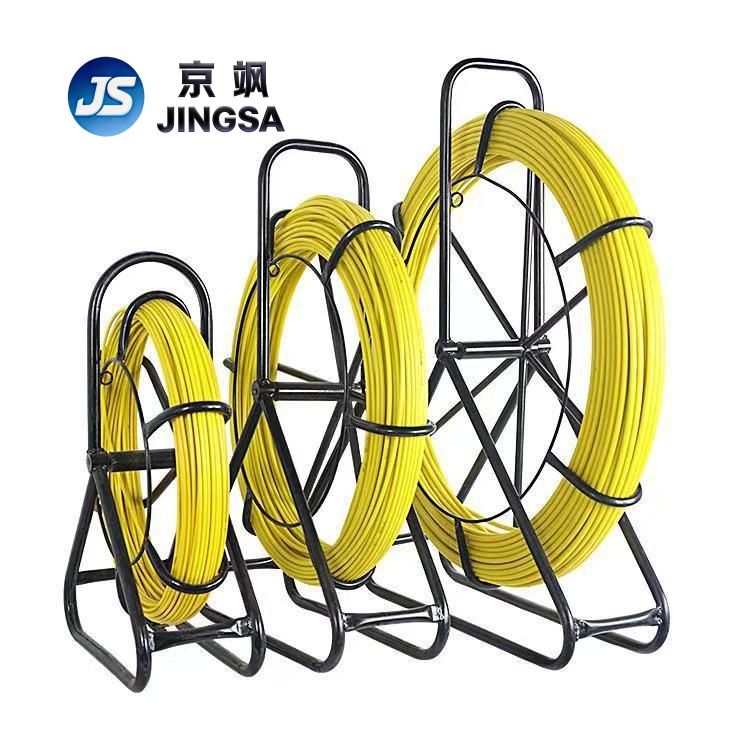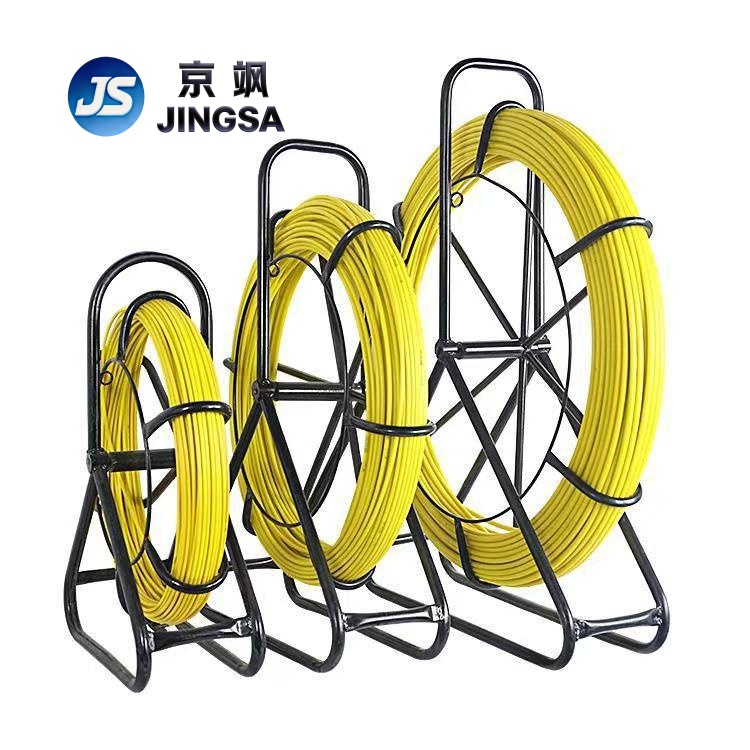
In the actual construction operations involving fiberglass cable rods, equipment abnormalities often arise from a combination
of factors, including complex working environments, poor cable conditions, improper tool selection, or human operational errors.
The ability to quickly and accurately identify the root cause of a fault and take targeted corrective measures is a core competency
for ensuring cable laying efficiency, controlling construction costs, and safeguarding operational safety. Below are seven typical
fault scenarios encountered during cable pulling operations, along with systematic troubleshooting procedures for reference by
field technical personnel.
I. Cable Rod Advancement Blocked or Completely Jammed
Fault symptom: The cable rod suddenly stops moving forward during pushing inside the conduit and cannot proceed.
Possible causes:
Hard obstacles inside the conduit (e.g., cement fragments, metal chips, welding slag)
Long-term water accumulation or sediment deposition at the bottom of the conduit, forming soft blockages
Sharp bends, reduced-diameter joints, or misaligned pipe sections not installed to specification
Troubleshooting steps:
Gently attempt to retract the rod backward. If resistance is uniform throughout, it is likely due to excessive friction against the
conduit wall; if resistance is concentrated at a specific point, a foreign object obstruction is highly probable.
In case of localized jamming, never force the rod forward, as this may cause bending or internal fiber breakage.
It is advisable to insert a probe from the opposite end of the conduit, or use inspection tools such as a borescope or pipe pig to
confirm internal conditions.
If necessary, open intermediate inspection pits or handholes to perform localized cleaning and dredging.
II. Cable Rod Slipping and Spinning at Bends
Fault symptom: When encountering multi-bend conduits or vertically upward sections, the front end of the rod contacts the
conduit wall but fails to transmit effective thrust, resulting in slipping and spinning in place.
Possible causes:
The selected rod diameter is too small, leaving excessive clearance with the conduit inner wall and inadequate support
The rod surface is too smooth, providing insufficient friction against the conduit wall
The FRP material is inherently rigid and brittle; improper handling at bends can exacerbate the issue
Troubleshooting measures:
Replace with a slightly larger diameter rod or one with a micro-textured surface to increase normal contact pressure against
the conduit wall.
Install a flexible guide tip at the front end of the rod to improve bend negotiating capability and directional guidance.
Adopt an alternating "push–pause–micro-rotate" technique during operation, allowing the rod to gradually conform to the bend
direction rather than forcing it through.
III. Rod Breakage or Unusual Noises During Pushing
Fault symptom: A crisp "snap" sound is heard during construction, accompanied by a sudden drop in pushing resistance, or the
rod noticeably loses supporting force.
Possible causes:
The rod has exceeded its service life, leading to aging and embrittlement of the resin matrix
Previous over-bending caused internal fiber damage
Encountering sharp obstructions causing localized stress concentration
Troubleshooting and handling:
Immediately stop work and locate the break point from both ends of the conduit.
If the broken section remains inside the conduit, retrieve it using a magnetic hook, borescope grabber, or by threading thin steel
wire from the opposite end, to prevent the debris from scratching the cable sheath during subsequent cable pulling.
The fundamental preventive measure is to inspect the rod body for signs of whitening, cracking, hardening, or exposed fibers
before each use. Special attention should be paid during low-temperature seasons, as the material becomes more brittle—the
product's applicable temperature range is –40°C to +80°C—and the rod should be pre-warmed or pushed at a reduced speed
as appropriate.
IV. Cable Rod Detaching from the Cable During Retraction Pulling
Fault symptom: During the retraction pulling process, the connection point between the rod and the cable to be laid becomes
loose, leaving the cable inside the conduit while the rod is pulled out alone.
Possible causes:
Insecure binding method (e.g., using only ordinary adhesive tape)
Failure to use a dedicated pulling head or anti-slip locking device
Pulling force exceeding the load limit of the connection point
Troubleshooting measures:
Upgrade the connection method: use high-strength ties combined with a dedicated pulling connector, or adopt a double-loop
dead-end binding technique.
Install a protective sleeve at the binding point on the cable to prevent damage to the sheath from the binding force, while also
providing an anti-slip function.
If detachment has already occurred and the rod has been retrieved, re-thread the conduit and reinforce the connection before
pulling again. Do not apply force blindly when the connection status is uncertain.
V. Sudden Release of Elastic Energy Causing Kickback Injury
Fault symptom: The rod, having stored elastic deformation energy inside a bent conduit, suddenly springs out at high speed after
the constraint is removed, endangering operator safety.
Possible causes:
Excessive retraction speed causing concentrated release of elastic deformation energy
Abrupt changes in conduit direction, leading to high stress accumulation at bends
Improper operator positioning, standing directly in front of the conduit opening
Safety inspection and precautions:
Operators must always stand to the side of the conduit outlet and never directly face the pipe opening.
Maintain a steady, uniform speed during retraction, and avoid jerking or rapid pulling.
For long-distance or large-diameter highly elastic rods, adopt a staged tension-relief method to gradually dissipate the elastic
energy accumulated inside the conduit.
The minimum bending diameter of FRP cable rods should not be less than 60 cm; special care should be taken when the conduit
angle is right-angled or less than 90 degrees.
VI. Surface Damage to the Rod Causing Subsequent Cable Sheath Scratching
Fault symptom: Although the rod successfully passes through the conduit, its surface develops burrs or exposed glass fibers, which
cause longitudinal scratches on the cable outer sheath during cable pulling.
Possible causes:
Metal burrs, welding slag, or rough joints on the inner wall of the conduit
Surface wear from repeated use in abrasive conduits
Troubleshooting and prevention:
Inspect the rod surface condition after each operation, with special attention to exposed fibers, burrs, or resin peeling.
It is recommended to establish a usage log for each cable rod, recording the number of uses and any harsh conduit sections
encountered. Perform targeted surface inspections on rods that have been used in abrasive conduits.
Minor surface damage should be smoothed by sanding; severe damage warrants immediate scrapping and the rod must not be
used for cable pulling.
VII. Hidden Hazard of Insulation Degradation in Damp or Contaminated Environments
Fault symptom: Although the rod body is made of insulating material, in high-humidity, high-salt-spray, or conductive dust
environments, surface contamination may form a leakage path, posing safety risks.
Possible causes:
Exposure to conductive dust or salt deposits on the surface during construction in underground cable galleries, tunnels, or
coastal areas
High ambient humidity causing surface condensation that reduces insulation performance
Troubleshooting measures:
Before each use, wipe the rod body surface with a clean dry cloth to remove dirt and salt that may adhere to the FRP surface.
Before high-voltage cable pulling operations, it is recommended to use a megohmmeter (insulation resistance tester) to measure
the surface insulation resistance of the rod and verify that it meets relevant safety standards.
After working in salt-spray or chemically contaminated environments, rinse the rod thoroughly with clean water and allow it to dry
completely before storage.
Summary and Systematic Preventive Recommendations
The various construction faults encountered with fiberglass cable rods ultimately stem from imbalances in the
"person–machine–environment" triad. Through standardized tool selection, rigorous pre-operation inspections, proper operating
techniques, and comprehensive post-use maintenance, the vast majority of faults can be effectively prevented or promptly
addressed at an early stage. Field personnel should firmly establish the mindset that "the cable rod is the first line of defense for
construction safety, not merely an auxiliary consumable," and integrate tool management into the routine quality control processes
of the project.
RELATED PROUDCTS