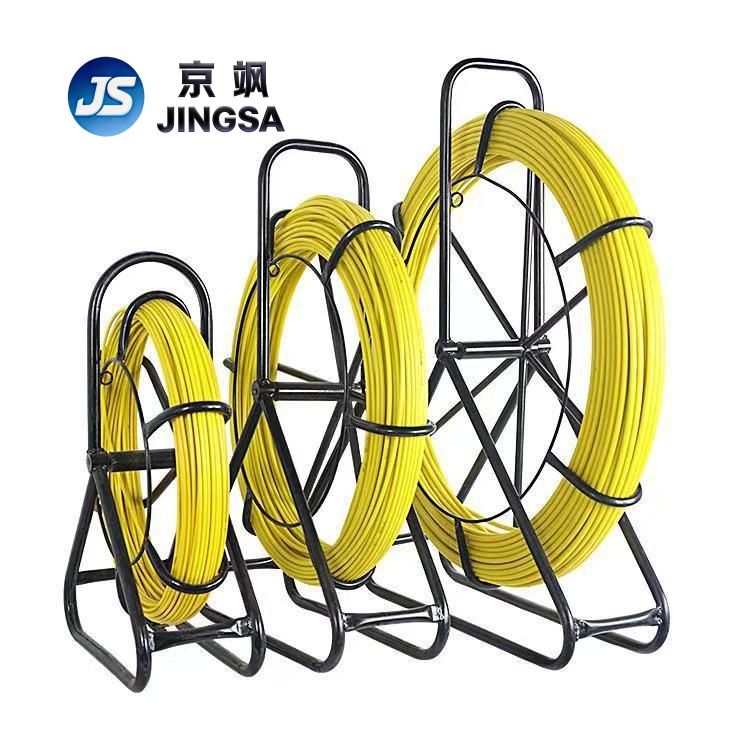
Technical Requirements for the Application of Fiberglass Cable Rods Under Complex Working Conditions
Under complex construction conditions, the application of fiberglass cable rods faces numerous technical challenges. Their performance is jointly determined by multiple factors including material properties,
structural design, operating procedures, and environmental adaptability. The following systematically elaborates on the key technical requirements under complex working conditions from six dimensions,
providing a reference for engineering selection and field application.
I. Mechanical Properties: Synergistic Matching of Tensile Strength and Bending Toughness
Complex working conditions typically involve multi-bend conduits, long-distance, narrow cable galleries, or path systems with obstacles. During operation, the cable rod is subjected to combined loads including
repeated bending, torsion, and axial tension. Its structural integrity requires the material to possess both sufficient tensile strength and bending toughness to avoid brittle fracture or irreversible deformation.
Key technical indicators:
Breaking strength: Common products range from 2.5T (approx. 24.5 kN) to 4.2T (approx. 41.2 kN) , subject to manufacturer product data
Bending performance: The minimum bending radius is generally 295mm to 330mm (varying by product diameter); engineering practice recommends a minimum bending diameter of no less than 60cm; industry
testing standards typically require a bending radius ≥ 5 times the rod diameter (≥5D)
II. Surface Quality and Wear Protection
When the cable rod passes through concrete-embedded conduits, metal sleeves, or aged pipes, the inner wall may contain burrs, rust, or deposits, which can easily cause scratches and surface damage. Once
surface fiber exposure or resin peeling occurs, it not only reduces the rod's service life but may also scratch the cable sheath during pulling.
Technical requirements:
The rod body surface shall be smooth and dense, without obvious pores or indentations – the cable rod outer surface is typically made of a high-density polyethylene (HDPE) protective sheath layer, providing
smoothness, wear resistance, aging resistance, and acid/alkali resistance
Depending on working conditions, a high-crosslinking resin system or surface wear-resistant coating may be selected (subject to actual product test reports) to enhance scratch resistance
For cable rods used in abrasive conduits, a dedicated surface inspection shall be conducted after use to confirm the absence of exposed fibers before storage
III. Environmental Adaptability: Wide Temperature Range and Corrosion Resistance Requirements
Under complex working conditions, cable rods may be exposed to high temperatures, low temperatures, high humidity, oil contamination, or even weak acid/alkali environments. For example, underground
cable galleries are perennially damp, chemical plant areas may contain trace corrosive gases, and outdoor operations are subject to continuous ultraviolet exposure.
Material selection requirements:
The resin matrix should preferably be weather-resistant vinyl ester resin or modified epoxy resin system, with good UV resistance, hydrolysis resistance, and chemical corrosion resistance
The stable operating temperature range is generally –40°C to +80°C (some premium products may support extended temperature ranges, subject to manufacturer product data)
Insulation performance: Surface insulation resistance shall preferably be no less than 1×10¹² Ω (or leakage current < 0.5mA at 500V test voltage), subject to manufacturer product data; in high-humidity or
salt-spray environments, surface insulation performance shall not significantly degrade
IV. Smart Function Integration: Real-Time Tracking and Condition Awareness
In long-distance conduits or paths with unclear routing, traditional cable rods cannot be easily located in real time or determine whether they have reached the outlet. Modern engineering has placed demands
on cable rods for functional integration, enabling visualization and traceability during the pulling process through the embedding of micro-sensing elements.
Integration directions:
Fiber optic sensing: Real-time monitoring of the rod's bending state and position inside the conduit
Conductive core: Enables continuity detection to determine whether the rod has completely passed through the conduit
RFID chip embedding: Enables full life-cycle identification and usage record traceability of the tool
Functional integration imposes extremely high requirements on manufacturing processes: functional elements must be well-composited with the rod body without affecting overall mechanical and insulation
performance
V. Operational Safety and Ergonomic Design
Complex working conditions typically require multi-person collaboration or mechanical assistance. The ease of operation and safety of the cable rod directly affect construction efficiency and personnel safety.
Design requirements:
The front end shall be equipped with a standardized quick-connect interface (such as M12 threaded connection), compatible with various guide heads, pulling ropes, and motorized pulling devices
Overall weight shall be controlled within a range manageable by a single operator while ensuring strength, reducing physical fatigue during prolonged operations
The rod body surface should have moderate friction (anti-slip design) for easy grip and operational control
Safety warning: During operations in bent sections, operators shall always stand to the side of the conduit opening and never directly face the axis direction of the opening
VI. Full Life-Cycle Quality Management and Traceability System
In critical infrastructure sectors such as nuclear power, rail transportation, and data centers, cable rods are no longer treated as disposable consumables but rather as an important link in the engineering safety
chain. Therefore, quality management must cover the entire process from production to disposal.
Manufacturer responsibilities:
Provide batch traceability records
Provide aging performance data and recommended replacement intervals (premium products can have a service life of 10 to 20 years)
Provide periodic testing recommendations (such as insulation resistance test intervals and surface inspection standards)
User responsibilities:
Establish a usage log for each cable rod, recording the number of uses, harsh conduit sections encountered, and abnormal conditions
Conduct mandatory retirement assessments on cable rods that have experienced extreme operating conditions (such as overload pulling, high-temperature exposure, or chemical contamination)
Timely phase out aged products in accordance with the manufacturer's recommended scrap criteria (such as extensive fiber exposure on the surface, brittle cracking sounds during bending, or insulation resistance
falling below safety thresholds)
Summary
The application of fiberglass cable rods under complex working conditions has evolved from a single-function pulling tool into a systematic solution integrating high-performance composite materials, smart
sensing elements, and engineering adaptability design. Its technical requirements span multiple disciplines including materials science, structural mechanics, electrical safety, and construction management.
Only through collaborative management between manufacturers and users can cable rods deliver their intended effectiveness and safety assurance under complex working conditions.
Recent Articles