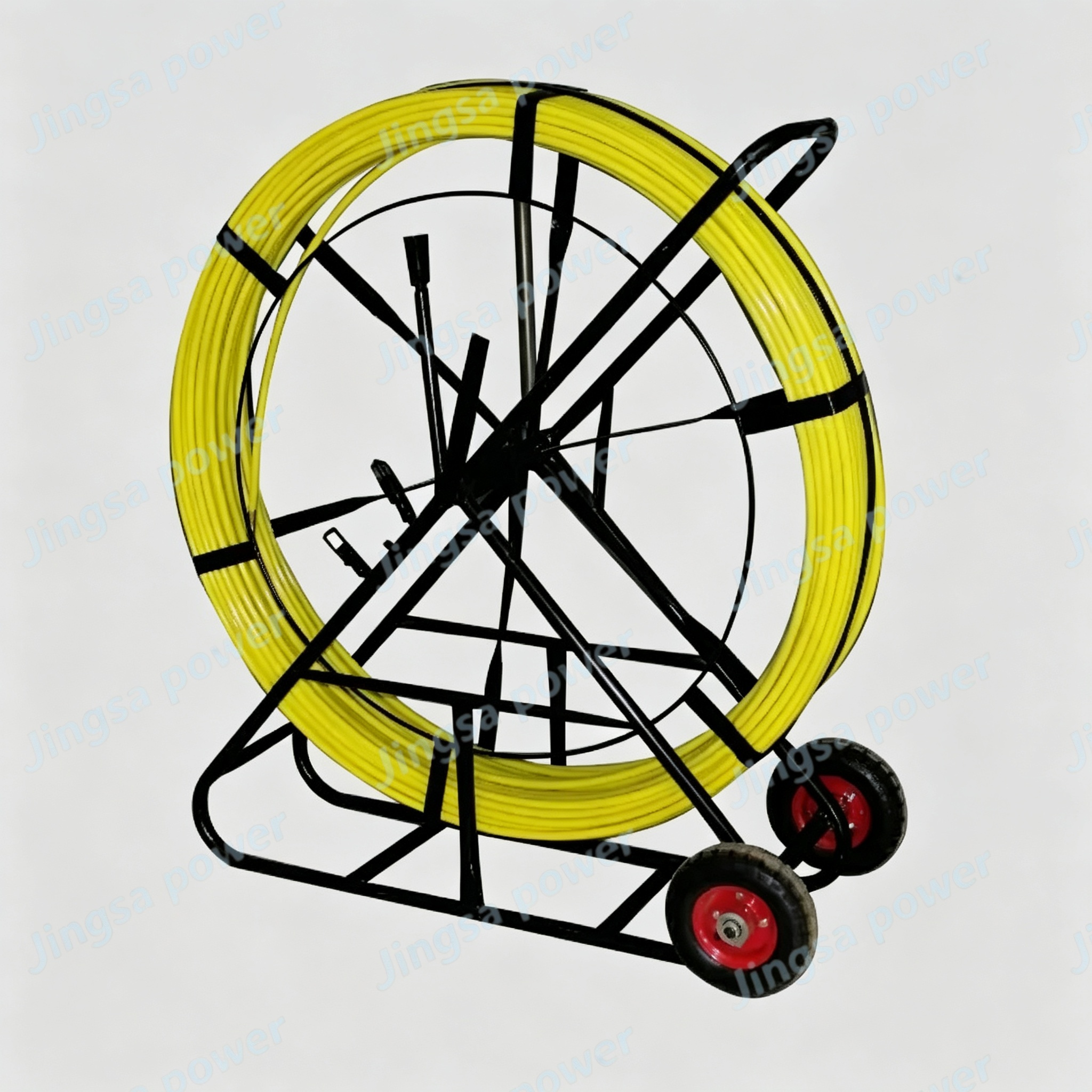
FRP cable rods, made from glass fiber reinforced plastic (FRP) as the core material, are flexible conduit-pulling tools that combine high strength, corrosion resistance, excellent insulation, light weight, and good bending performance. They are essential auxiliary tools in power and communication engineering for solving construction challenges related to cable laying, conduit threading, and wire pulling. These tools are widely applicable to overhead lines, underground conduits, building shafts, and narrow cable trenches, significantly improving cable installation efficiency and safety while effectively reducing labor and equipment costs.
1.Material Properties and Core Value
FRP cable rods use a glass fiber reinforced resin matrix, which endows them with a range of properties tailored to the needs of power and communication construction, making them an ideal choice to replace traditional metal pulling tools such as steel wire and iron wire:
(1) Electrical Insulation
The rod body is non-conductive. When working near high-voltage power lines, operating in proximity to energized equipment, or laying communication cables in the same conduit as power cables, it effectively reduces safety hazards such as short circuits and electric leakage, protecting both personnel and equipment.
(2) High Strength and Lightweight Design
With excellent tensile strength (common products have a breaking strength of up to 2.5T), it can withstand the pulling loads required for long-distance hauling. At the same time, its overall weight is far lower than that of metal pulling tools, allowing single-person operation. This makes it particularly suitable for construction environments such as elevated towers, underground shafts, and narrow conduits where heavy equipment is difficult to transport.
(3) Weather Resistance and Corrosion Resistance
It offers excellent resistance to acids, alkalis, ultraviolet radiation, and moisture. Under harsh conditions such as outdoor overhead lines, underground conduits (soil corrosion environments), underground shafts (high-humidity environments), and chemical industrial parks, it does not rust, age, or deform easily over long-term use, and its service life is significantly superior to that of metal pulling tools.
(4) Good Bending Performance
With good bending flexibility, it can navigate through complex conduits with elbows and bends, as well as vertical shafts, effectively solving the problem of pulling wires through tortuous paths. After coiling, it occupies a small volume, facilitating transportation and on-site storage.
(5) Low Friction Coefficient
The surface is smooth, and some models feature an additional wear-resistant coating. During conduit threading, friction between the rod and the conduit inner wall or cable sheath is minimal, which not only prevents scratching of the cable insulation layer but also effectively reduces pulling resistance and improves construction efficiency.
2. Typical Application Scenarios in Power Engineering
In the power engineering field, FRP cable rods are used throughout the entire process, from high- and low-voltage distribution line laying, power cable installation, substation wiring, to indoor and outdoor power pipeline retrofitting, covering all stages from new construction to later maintenance:
(1)Underground/Pre-buried Conduit Cable Laying
In the underground power networks of urban roads, residential communities, and industrial parks, pre-buried PVC, PE, or galvanized steel conduits often feature multiple bends and long distances. During construction, the rod is first inserted from one end of the conduit to the other, then the power cable is securely connected to the rod tip, and the cable is pulled through by retracting the rod. This method effectively replaces the inefficient traditional practice of manually threading steel wire, significantly shortening the construction period.
(2)Overhead Power Line Auxiliary Construction
In the erection of high-voltage overhead lines and cross-arm wiring, the rod’s bending performance and spanning capability are utilized to first pull it across the span between utility poles or towers, and then use it to pull the conductors and lightning protection wires. This technique effectively avoids the safety risks of manual high-altitude hauling and significantly improves overhead construction efficiency.
(3)Wiring Inside Substations and Switchgear Rooms
In substations and switchgear rooms, cabinets are densely arranged, conduits are complex, and insulation requirements are extremely stringent. FRP cable rods can flexibly navigate through confined spaces such as distribution cabinets, cable trenches, and shafts, enabling precise laying of high- and low-voltage cables and control cables, and fundamentally reducing the risk of equipment faults caused by metal tool conductivity.
(4)Power Pipeline Retrofitting and Maintenance
During the retrofitting of aging power pipelines, the existing conduits may contain sediment deposits or aged cables. FRP cable rods can smoothly pass through mildly blocked sections to pull and replace new cables. During line maintenance, they can also be used for temporary wire pulling, effectively reducing outage durations.
(5)Vertical Laying in Cable Shafts and Power Shafts
In high-rise buildings and power plants, cables in power shafts need to be laid vertically. Utilizing the rod’s high tensile strength, it is inserted from the top of the shaft to the bottom, then used to pull the cable vertically downward. This effectively prevents damage to the insulation layer caused by the cable’s own weight dragging during installation, while also reducing the difficulty of manual operation.
3. Typical Application Scenarios in Communication Engineering
Communication engineering is one of the core industries where FRP cable rods are most widely applied. They fully accommodate the laying needs of fiber optic cables, communication network cables, and coaxial cables, covering all scenarios of operators such as radio & television, China Telecom, China Mobile, and China Unicom, including basic network construction, broadband access, and base station wiring:
(1)Main Communication Conduit Trunk Line Laying
Urban communication trunk networks mostly use underground corrugated pipes, multi-hole pipes, or silicone core pipes, which commonly feature multiple bends and long single-section distances (up to several hundred meters). FRP cable rods are the core tool for this scenario – the rod is first pushed through the entire conduit section, then used to pull the optical cable bundle, achieving efficient laying of trunk optical cables, significantly improving network construction efficiency and reducing labor costs.
(2)FTTH (Fiber to the Home) End-User Wiring
FTTH is one of the most frequently encountered scenarios in communication engineering. The conduits from the community weak-current pit to the resident’s premises are mostly small-diameter PVC pipes with multiple bends. Small-diameter FRP cable rods (diameter 3–12 mm, common specifications include 4.5 mm, 6 mm, and 8 mm) can easily pass through indoor small conduits to pull fiber optic drop cables precisely. They are indispensable tools for home renovation and community broadband retrofitting projects.
(3)Communication Base Station Integrated Wiring
In 5G/4G communication base stations, the space for cable laying between equipment rooms, towers, and poles is extremely limited, with high requirements for insulation and lightweight tools. FRP cable rods can efficiently handle the pulling of optical fibers, feeders, and power cables within the base station, while also accommodating cable connections for outdoor overhead and underground conduits at the base station site, effectively accelerating base station construction.
(4)Overhead Communication Line Construction
In the construction of overhead communication lines in rural and suburban areas, FRP cable rods are used to pull optical cables across spans between utility poles, replacing traditional iron wire pulling methods. This not only avoids the risk of cable detachment caused by rusting and breakage of iron wire, but also, due to the rod’s light weight, allows single-person high-altitude pulling operations, significantly reducing construction difficulty.
(5)Network Maintenance, Capacity Expansion and Blockage Removal
During later capacity expansion of communication networks, new optical cables need to be added to existing conduits. FRP cable rods can pull new optical cables without damaging the original conduits or existing cables, enabling low-cost network expansion. When the conduit network experiences mild blockages, it can be used in conjunction with a pipe cleaner for unblocking, followed directly by cable laying, achieving two objectives at once.
(6)Integrated Weak-Current Wiring in Buildings
In integrated weak-current wiring projects for office buildings, shopping malls, and similar structures, network cables, telephone lines, and surveillance cables need to pass through suspended ceilings, wall conduits, and floor cable trays. FRP cable rods can flexibly pull wires in narrow cable trays and conduits, effectively avoiding cable tangling and scratching, while improving the standardization and efficiency of integrated wiring.
4. Accessories and Cross-Industry Application Extension
To meet the differentiated needs of various construction scenarios, FRP cable rods are typically used in combination with multiple accessories to further expand their functional capabilities:
| Accessory Name | Function |
| Steel head/Copper head | Installed at the front end of the rod to enhance obstacle-breakingcapability, easily passing through minor sediment or burrs insidethe conduit |
| Pulling hook | Provides a secure connection between the rod and the cable orpulling ring, preventing accidental detachment during pulling |
| Cable reel/Stand | Enables orderly coiling and smooth release of the rod,accommodating the operational needs of long-distanceconstruction |
| Guide pulley | Installed at the conduit opening or at bends to reduce frictionwear on the rod at turning points, extending service life |