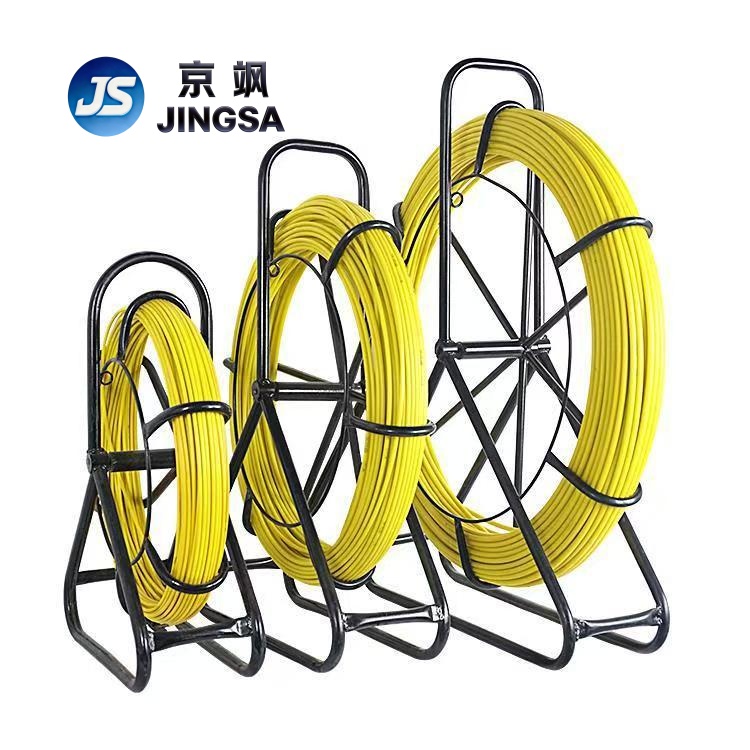
FRP cable rods (fiberglass cable rods) are non‑metallic conduit‑pulling tools made of glass fiber reinforcement and resin matrix composites. They are widely used in power cable, communication optical cable, and building conduit installation projects. Their core advantages include excellent insulation performance, chemical corrosion resistance, moderate flexibility, light weight, and non‑conductivity. To ensure operational safety, improve pulling efficiency, and extend service life, operators must master proper construction methods and implement routine maintenance procedures.
1. Pre‑operation Preparation and Inspection
(1) Visual integrity check
Before use, visually inspect the entire length of the cable rod to ensure the surface is smooth and free from cracks, burrs, delamination, or localized bulges. If exposed glass fibers or resin peeling are found, stop using the rod immediately to prevent damage to the cable or optical fiber outer sheath during pulling.
(2)End fitting inspection
Verify that the front guide head (usually made of copper‑plated metal or engineering plastic) is securely connected to the rod body without looseness or stripped threads. If the rod has a bare end face, smooth it with fine sandpaper to remove any sharp edges that could scratch the cable.
(3) Length confirmation
Select the appropriate rod length based on the actual conduit path length and number of bends. Common coil lengths include 50 m and 100 m, and custom lengths (shorter or longer) are also available—typical product ranges cover 10 m to 500 m.
2. Standard Pulling Procedure
(1) Conduit pre‑cleaning
Before pulling, use compressed air or a dedicated pipe cleaner to remove dust, gravel, standing water, and metal burrs from the embedded conduit, ensuring the inner wall is clean and clear. For conduits that have been unused for a long time, it is recommended to first run a cleaning sponge through to verify there is no blockage before formal operation.
(2) Lubrication for friction reduction (as needed)
When the conduit has many bends or a long pulling distance, apply a specialized pulling lubricant evenly on the rod surface or inject it into the conduit wall to significantly reduce friction between the rod and the conduit.
(3)Insertion and advancement
Insert the front end of the rod slowly and steadily into the conduit opening. At bends, gently rotate the rod forward and backward to help it navigate the curved sections using its inherent flexibility. Never force the rod with brute strength—FRP material is rigid and brittle, and excessive force can cause local kinking or internal fiber fracture. For extra‑long distances or complex multi‑bend sections, auxiliary guide wheels or power‑assisted pulling devices may be used.
(4) Cable connection and securing
After the rod emerges from the far end of the conduit, securely connect its front end to the cable or optical fiber to be pulled using a dedicated connector or high‑strength webbing. The attachment point should be on the cable’s strength member (e.g., aramid yarn or central strength member) to avoid pulling only on the outer sheath, which could cause sheath detachment. Perform a pre‑tension test after connection to ensure it is firmly secured.
(5)Steady retraction pulling
Pull the rod back from the insertion end at a steady, uniform speed, drawing the cable smoothly through the conduit. Maintain constant speed and even force during the entire pulling process. Never jerk, stop abruptly, or change speed suddenly, as instantaneous impact loads can break the rod or damage the cable.
3. Safety Prohibitions
Overload prohibition: Do not pull cables or wires exceeding the rated pulling force of the rod (typical breaking strengths range from 2.5T to 4.2T, subject to manufacturer specifications). Also, do not force the rod through bends with a bending radius smaller than its minimum allowable radius.
Heat and chemical source prohibition: Keep the rod away from open flames, high‑temperature sources, and strong acid or strong alkali solvent environments to prevent resin matrix deformation or chemical attack. The product’s applicable temperature range is generally –40°C to +80°C.
Bending radius control: The bending radius during use shall not be less than 5 times the rod’s own diameter (industry test standard requires ≥5D). In addition, note that the specific minimum bending radius is subject to the manufacturer’s data (for example, common φ9 mm and larger rods have a minimum bending radius of 330 mm). As a practical engineering guideline, the minimum bending diameter should preferably not be less than 60 cm.
Personal safety protection: When operating in narrow manholes or confined spaces, personnel must wear protective gloves to prevent injury from rebound when the rod springs back.
4. Routine Maintenance and Care
(1) Post‑use cleaning
After construction, immediately remove mud, oil, and other debris from the rod surface using a dry cloth or soft brush. If oily stains or chemical residues are present, wipe with a neutral detergent and a damp cloth. Never clean with acetone, benzene, or strongly polar solvents, as these will attack the resin matrix and cause surface cracking or strength reduction.
(2)Storage requirements
Store the rod in a dry, cool, and well‑ventilated indoor location, protected from direct sunlight (UV exposure accelerates resin aging and embrittlement). The rod is typically stored on dedicated racks or trolleys. When coiled, the winding diameter should not be too small—follow the manufacturer’s recommended core diameter (generally ≥30 cm is suggested) to avoid permanent set deformation from prolonged coiling. Do not place heavy objects on top of the rod or suspend heavy loads from it during storage, as this can cause localized indentations or internal micro‑cracks.
(3)Periodic inspection schedule
It is recommended to perform a comprehensive inspection of the rod every quarter or before each major project, covering:
Surface condition: whitening, cracking, or exposed glass fibers indicating aging;
Bending performance: normal flexibility without obvious hardening or brittleness;
End connectors (including metal parts): looseness, corrosion, or thread damage.
(4) Service life and scrap criteria
The service life of FRP cable rods varies with product quality and usage frequency—ordinary products generally last more than 1 year, while high‑quality rods made with imported alkali‑free fibers can last 10 to 20 years. The rod should be immediately taken out of service and scrapped if any of the following conditions occur:
Obvious delamination, blistering, or extensive fiber exposure on the surface;
A brittle cracking sound or snap during bending, indicating a significant drop in bending strength;
Abnormal insulation performance (for high‑voltage pulling environments, insulation resistance should be periodically tested; the acceptance criteria shall be in accordance with manufacturer specifications or relevant insulation tool test standards such as ASTM F3121).